Can you really trade meme coins with a $10 portfolio and still come out ahead?
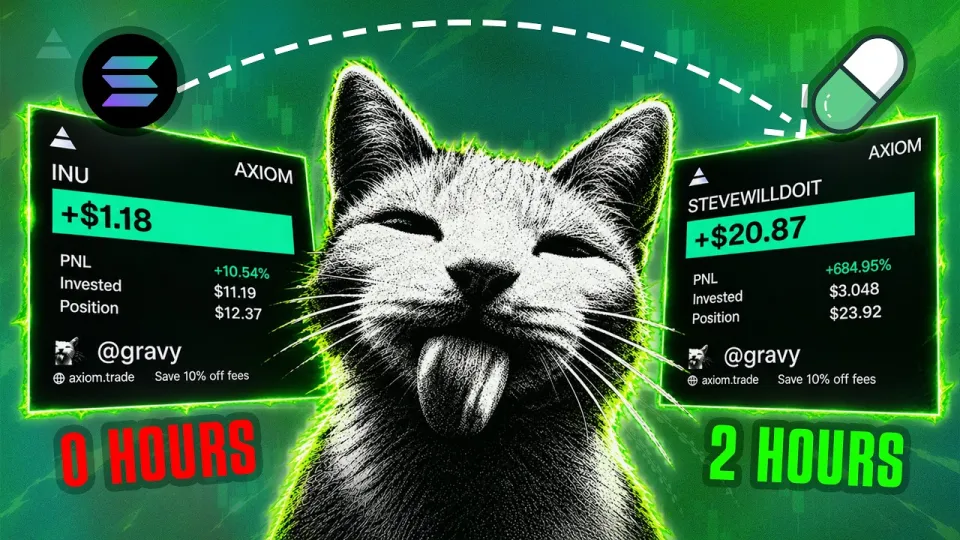
Video: I Tried Trading Memecoins with Just $10
You can order the same kind of articles for your own video to boost it on YouTube and Google. Just message the Telegram bot @sat_sit_bot. It writes articles around your video, embeds the video and publishes them on popular niche websites (no ads). Free trial — 50 articles.
· based on the channel gravy
Key takeaways
- Five real Solana meme coin trades, each buy kept under 0.05 SOL — roughly the size a $10–$20 balance allows.
- Tickers covered: STEVEWILLDOIT, NPC, MET (Meteora), PUMPY the Trader and UNTXD.
- Fees are the main constraint on micro positions: Axiom referral links advertise 2x cashback and 15% lower fees.
- Narrative timing (the X Money / e-acc meta) mattered more than chart patterns on these trades.
- The host floated live trading from 0.1 SOL or 1 SOL with a doxxed wallet as the next test.
Yes — you can trade meme coins with a $10 portfolio, but the size of your edge is set by fees and position sizing, not by picking the perfect coin. In a five-trade experiment on Solana, every buy stayed under 0.05 SOL, and the results hinged on how fast each narrative was recognised and exited. The trades were executed through Axiom, the trading terminal used in the video, which offers referral cashback and reduced fees.
What a $10 meme coin portfolio actually looks like on Solana
A $10 balance on Solana is roughly 0.05–0.07 SOL depending on price, which means every position is a micro-cap trade where fixed costs are proportionally huge. The experiment deliberately capped each buy below 0.05 SOL, so the trader was never fully in one coin and always kept SOL for the next setup.
Three practical consequences follow from that budget:
- Fees dominate. A swap on a Solana aggregator plus priority fees and slippage can eat a meaningful share of a position this small; the video's referral pitch (2x cashback, 15% lower fees) exists precisely because of that drag.
- You cannot average down meaningfully. With one buy per coin, entries must be right the first time or cut fast.
- Exit speed beats exit price. On micro positions, taking a 20–40% gain quickly is often better than waiting for a runner that may never come.
The broader lesson for anyone searching how to trade meme coins with a small bankroll is that the strategy has to be built around cost control first and coin selection second.
The five trades: STEVEWILLDOIT, NPC, MET, PUMPY and UNTXD
Each of the five trades followed a narrative thesis rather than a technical setup, and the tickers map to distinct meta stories on Solana. The list below summarises what each position was really a bet on.
- STEVEWILLDOIT — a personality-driven meme built around a well-known internet character; the trade depended on whether the joke had legs beyond the first wave of buyers.
- NPC — a coin riding the broader "NPC" internet meme, where the risk is that the name is generic and liquidity rotates away quickly.
- MET (Meteora) — a ticker tied to the Meteora ecosystem, which makes it a proxy bet on attention around a real Solana project rather than a pure joke.
- PUMPY the Trader — a mascot-style coin launched in the pump.fun ecosystem, where launch velocity and holder distribution decide survival.
- UNTXD — the trade the host admits fumbling, which is the most instructive of the five: a good thesis executed with bad timing still loses money.
What connects them is that none was bought on a chart pattern alone. The entry case in every instance was "is this story spreading right now, and am I early?"
Why the X Money meta moved and how narratives get priced in
The X Money coin narrative ran because it combined a recognisable product story with a community of builders pushing an accelerationist, e/acc-style message. When a meme attaches to something people already talk about — a payments feature, a founder, a cultural fight — the first buyers are not buying a token, they are buying a share of the conversation.
That has a practical implication for small portfolios. Narrative coins move in three phases: discovery (a few accounts post, price is flat), acceleration (timelines fill, volume spikes) and distribution (late buyers provide exit liquidity). A $10 trader can only profit in the first two phases, because there is no room to average down through phase three.
The video's Meteora trade is a useful contrast: it borrowed attention from an established Solana protocol, so the ceiling was lower but the floor was more defensible than a pure joke coin.
The typical mistakes small meme coin traders make
The most common failure pattern is not picking bad coins — it is buying a dip in a coin whose narrative has already peaked. Traders report selling after a 20–40% drawdown only to watch the price recover later, or holding through a run that never comes back.
A workable checklist for micro positions:
- Write the thesis in one sentence before buying. If you cannot, you are gambling.
- Check who is talking about it and whether those accounts have reach; a narrative with no distribution is just a ticker.
- Set the invalidation level before entry, not after the first red candle.
- Size so that a total loss does not end the session — under 0.05 SOL per buy leaves room for four or five attempts.
- Log every trade with entry, exit and reason, because with positions this small the pattern across trades matters more than any single result.
The other recurring complaint is information overload: too many tweets, too many influencers to track. The fix is narrowing the feed to a handful of accounts that historically front-run metas, rather than trying to read everything.
Where to trade and what the fees really cost
The terminal matters as much as the coin when your position is under 0.05 SOL, because a few tenths of a percent in fees and priority tips changes whether a trade is profitable at all. The video routes trades through Axiom and promotes its referral programme, which advertises 2x cashback and 15% lower fees — meaningful on micro positions, marginal on large ones.
Beyond the terminal, two cost levers are worth knowing:
- Priority fees on Solana rise during congestion; paying the minimum can mean a failed or delayed fill on a fast-moving launch.
- Slippage settings that are too loose on thin liquidity effectively hand value to faster traders.
A separate lever mentioned in the video's links is futures fee reduction through a partner exchange, which is relevant only if you trade derivatives alongside spot meme coins — a very different risk profile from a $10 spot experiment.
What the audience asked about trading meme coins on a tiny balance
The questions viewers raised after the experiment cluster around three themes: whether small portfolios are viable at all, how to find coins with good narratives, and what the final profit and loss actually was.
On viability, the honest answer is that it is possible but the margin for error is thin — a single badly timed entry can wipe out several good ones. On narratives, the skill is not reading every tweet but recognising which stories have already proven they can spread, then waiting for a fresh catalyst rather than chasing the third day of a run. On results, the video stops short of a clean total P&L breakdown, which is a fair criticism: without the aggregate number, individual wins look better than the strategy may be.
There is also demand for the next step — a live session starting from 0.1 SOL with a doxxed wallet, so viewers can see entries and exits in real time instead of a curated recap.
Useful links
- Trade on Axiom (referral, 2x cashback and 15% lower fees): https://axiom.trade/@gravy
- The Trenches Discord: https://discord.gg/W7TqkExcSd
- Free Axiom imports and trade signals (NFA): https://discord.gg/9W5j3XUgYB
- Follow the host on X: https://x.com/gravyski
- Leverage trading with 20% futures fee reduction: https://www.bitbase.com/landing-page/trading-earning-Gra?ref=8CYOGY
Final takeaway
Trading meme coins with $10 is a fee-management exercise wrapped in a narrative-timing exercise; the coins are the variable, but costs and exits decide the outcome. The five trades in this experiment — STEVEWILLDOIT, NPC, MET, PUMPY and UNTXD — show that a clear thesis plus a fast exit beats a clever ticker held too long. The fumbled trade is the most useful case study, because it isolates execution from luck. The breakdown comes from the gravy channel, which also plans a live session from 0.1 SOL with a doxxed wallet. If you want to replicate the setup, start through Axiom with the referral link and keep every buy under 0.05 SOL until the log shows a repeatable edge.
Questions & answers
Can you actually trade meme coins with only $10?
Yes, but the constraint is fees rather than coin selection. On Solana, $10 buys roughly 0.05–0.07 SOL, so each position must stay small enough that swap fees, priority fees and slippage do not consume the gain. The realistic approach is several micro positions with fast exits instead of one concentrated bet.
How do you find meme coins with a strong narrative?
Focus on stories that are already spreading and have a catalyst, rather than scanning every token launch. Track a short list of accounts that historically surface metas early, and check whether the meme connects to something people already discuss — a product, a founder or a cultural argument. If the thesis cannot be stated in one sentence, skip the trade.
Why do small meme coin trades lose money even when the coin later goes up?
Because the narrative often peaks before the trader enters, and a $10 position cannot be averaged down through a drawdown. Many traders sell after a 20–40% loss and then watch the price recover without them. Setting an invalidation level before entry and sizing so a total loss is survivable fixes most of this.
What fees should a beginner expect when trading meme coins on Solana?
Expect the aggregator or terminal fee, Solana network fees, priority fees during congestion, and slippage on thin liquidity. On positions under 0.05 SOL these add up quickly, which is why referral programmes advertising cashback and lower fees are promoted heavily. Loose slippage settings on illiquid coins are effectively an extra cost.
Source: I Tried Trading Memecoins with Just $10 · Markdown version